On November 1st, France comes to a halt. Roads lead to cemeteries, markets overflow with golden chrysanthemums, and church bells ring for all saints, known and forgotten. All Saints' Day is much more than a public holiday: it's a Christian celebration with deep roots, often confused with All Souls' Day or even Halloween. Here's everything you need to know about its history, meaning, and traditions, what you can offer (the digraph for example) to understand what is truly commemorated every November 1st.
What is All Saints' Day?
All Saints' Day, a contraction of "All Saints," is a Christian holiday celebrated every November 1st. It is specific to Catholics and Orthodox Christians and is absent from the Protestant calendar in this form. Its purpose is universal: to honor all the saints of the Church, whether they have been officially canonized by Rome or have lived in the shadows, anonymous and discreet.
November 1st has been a public holiday in France since the Concordat of 1801, signed between Napoleon Bonaparte and Pope Pius VII. This civil status has largely contributed to anchoring All Saints' Day in French culture, far beyond Catholic practitioners.
Unlike Christmas, Easter, or Pentecost, All Saints' Day has no direct biblical anchor. It originates from a popular cult of the early Christian centuries, progressively structured by the Church of Rome. Since Pope Pius X, the All Saints' Day mass is a liturgical obligation for practicing Catholics.
A joyful celebration, not just a day of mourning
This is perhaps the most important and most often forgotten nuance: All Saints' Day is a celebration of joy, oriented towards hope and holiness, not towards mourning. The Conference of Bishops of France formulates it thus: "All men are called to holiness, by different paths, sometimes surprising."
Holiness is not reserved for extraordinary figures. It is accessible to everyone, in everyday life, in simple gestures and faithful loves. This is the message that All Saints' Day has carried for centuries.
The concept of the communion of saints is at the heart of this celebration: living and deceased are united in the same faith, the same Church, the same prayer. All Saints' Day is therefore not a look towards death, but a look towards light.
History and origin of All Saints' Day: from Roman martyrdom to November 1st
The history of All Saints' Day was built over several centuries, between the Christian East of the first martyrs and the pontifical decisions of Rome. Two major stages shaped its current appearance.
The first martyrs and the Eastern Church (4th-5th century)
In the very first Christian communities, in Syria, Egypt, and Anatolia, a feast already existed to honor the martyrs, those men and women who had preferred death to renouncing their faith. It was held on the Sunday after Pentecost.
Roman persecutions, until the Edict of Constantine in 313, made martyrs almost all of the first saints. Their lists proliferated locally, each community keeping its own records. Faced with this dispersion, the Church felt the need to centralize: a single feast, for all saints, all together.
Pope Boniface IV and the official birth (609-610)
In 609, Emperor Phocas offered Pope Boniface IV the Pantheon in Rome, an ancient temple dedicated to all the gods of antiquity. Boniface had the bones of martyrs extracted from the catacombs transported there and consecrated the edifice as the "Church of Saint Mary and the Martyrs" on May 13, 610.
This date, May 13, then became the anniversary of the consecration and the first official feast of all saints and martyrs. All Saints' Day was therefore initially celebrated in spring, in May, and not in autumn.
Pope Gregory IV and the choice of November 1st (9th century)
In the 8th century, Pope Gregory III dedicated a chapel in St. Peter's Basilica to all saints and began to associate the celebration with November 1st. Around 830-835, with the support of Emperor Louis the Pious, his successor Gregory IV officially imposed this date on all of Western Christendom.
The choice of November 1st is not insignificant. It responds to a Christianization strategy: replacing the great Celtic festival of Samhain, deeply rooted in the populations of Northern Europe, with a Christian celebration of the same magnitude.
Celtic festival of Samhain: why November 1st?
Samhain (or Samain) is one of the four great sacred festivals of the Celtic calendar, celebrated on the night of October 31st to November 1st. It marked both the end of the harvest, the transition from the light season to the dark season, and the beginning of the new Celtic year.
But Samhain also had a powerful spiritual dimension: the belief that the boundaries between the world of the living and that of spirits diminished, that ancestors could return among their own. Fires were lit on the hills, lights were placed to guide or protect.
The Church deliberately chose this date to Christianize a celebration too deeply rooted to be suppressed. It took up certain symbolic elements, such as lights and the memory of ancestors, giving them Christian content. This substitution mechanism is not unique to All Saints' Day: Christmas proceeded in the same way with the winter solstice.
To remember: The word "Halloween" comes from the English "All Hallows' Eve", literally "the eve of All Saints' Day". The holiday of costumes and candy is therefore, etymologically, the eve of the Christian feast. Same root, radically opposite atmospheres.
All Saints' Day or All Souls' Day or Halloween: the differences at a glance
The confusion between these three celebrations is extremely common. The table below allows them to be clearly distinguished, before returning to them in detail.
| Criterion | All Saints' Day | All Souls' Day (Commemoration of the Dead) | Halloween |
|---|---|---|---|
| Date | November 1st | November 2nd | October 31st (evening) |
| Origin | Christian (Catholic) | Christian (Catholic) | Celtic (Samhain) |
| Who is honored? | All saints, known or unknown | All ordinary faithful departed | Spirits, creatures, imagination of death |
| Public holiday in France? | Yes (since 1802) | No | No |
| Dominant tone | Joyful, spiritual | Contemplation, remembrance | Festive, scary |
| Associated practices | Mass, prayer | Cemetery, flowers, candles | Costumes, candy |
The confusion between All Saints' Day and All Souls' Day is easily explained: November 1st, a public holiday, is the only time families can gather to lay flowers on graves. So, a practice that liturgically corresponds to November 2nd is advanced to the 1st.
All Saints' Day celebrates the saints. November 2nd prays for the ordinary deceased. These are two distinct intentions, even if they naturally follow each other in the same spiritual continuity.
What does All Saints' Day mean for Christians today?
For practicing Catholics, the feast of All Saints' Day is a holy day of obligation: they have a liturgical obligation to attend. But beyond the rite, All Saints' Day is an invitation to rethink what holiness means.
The Church does not only celebrate officially canonized saints, whose list numbers more than ten thousand names. It also celebrates millions of anonymous saints: those who loved with constancy, who forgave quietly, who went through trials without breaking down. Holiness is not reserved for cathedral statues.
The doctrine of the communion of saints gives this feast its particular depth: living, deceased, and saints form one and the same Church, united in prayer and hope. All Saints' Day is the moment when this invisible unity becomes visible.
All Saints' Day, a time of remembrance and hope
Contrary to what the autumnal atmosphere might suggest, All Saints' Day is a celebration oriented towards light. The contemplation it inspires is not one of mourning, but one of hope: faith in life that continues, differently, beyond the visible.
Liturgically, the celebration begins with vespers on the evening of October 31st and concludes on the evening of November 1st. It naturally extends into November 2nd, when prayer turns to all the deceased of the Church.
For many non-believers, why go to the cemetery on All Saints' Day answers another logic: that of family memory, of the bond maintained with those who have passed away, of transmitting to children the memory of their ancestors. All Saints' Day then becomes a secular festival of memory, shared far beyond religious boundaries.
Traditions and symbols of All Saints' Day in France
The feast of All Saints' Day is deeply rooted in French culture, whether one is a believer or not. Certain symbols have become so associated with it that they structure the weeks preceding it.
The chrysanthemum, emblematic flower of All Saints' Day
The chrysanthemum has become the flower of All Saints' Day for very practical reasons: it flowers late in autumn, withstands the cold, and is available in large quantities exactly around November 1st. Each year, approximately 25 million pots are sold in France around this period.
In the language of flowers, the chrysanthemum evokes fidelity, longevity, and immortality. In France, it is associated with mourning and cemeteries. But in other cultures, particularly in China and Japan, it symbolizes celebration and joy. The same object, inverse meanings depending on the perspective.
A nuance is necessary: the chrysanthemum mainly decorates graves on November 2nd, All Souls' Day. It is the public holiday of the 1st that makes it an All Saints' Day flower in popular usage.
The visit to the cemetery and the decoration of graves with flowers
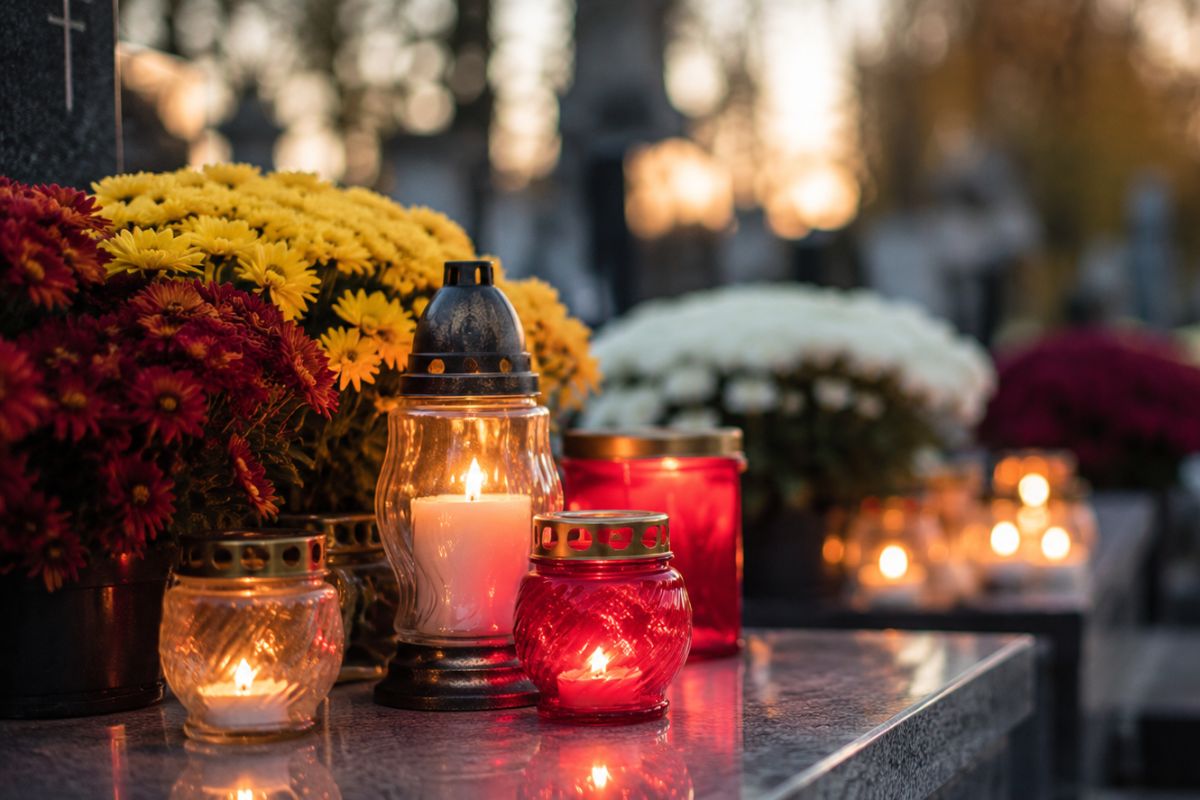
Going to the cemetery on All Saints' Day is a tradition shared by millions of French people, believers and non-believers alike. People lay flowers on graves, reflect, and sometimes meet family members they only see on this occasion.
This practice is historically linked to November 2nd, but advanced to November 1st because it is the only non-working day of the period. Families can gather without professional constraints. The tradition is shared throughout Catholic Europe: Italy, Spain, Poland, with often very vibrant local variations.
Please note: Laying flowers on a grave on November 1st is liturgically anticipating the Commemoration of the Dead on November 2nd. All Saints' Day itself celebrates the saints, not the ordinary deceased. This distinction, often ignored, nevertheless explains the difference in tone between the two days.
Candles, lights, and other symbols
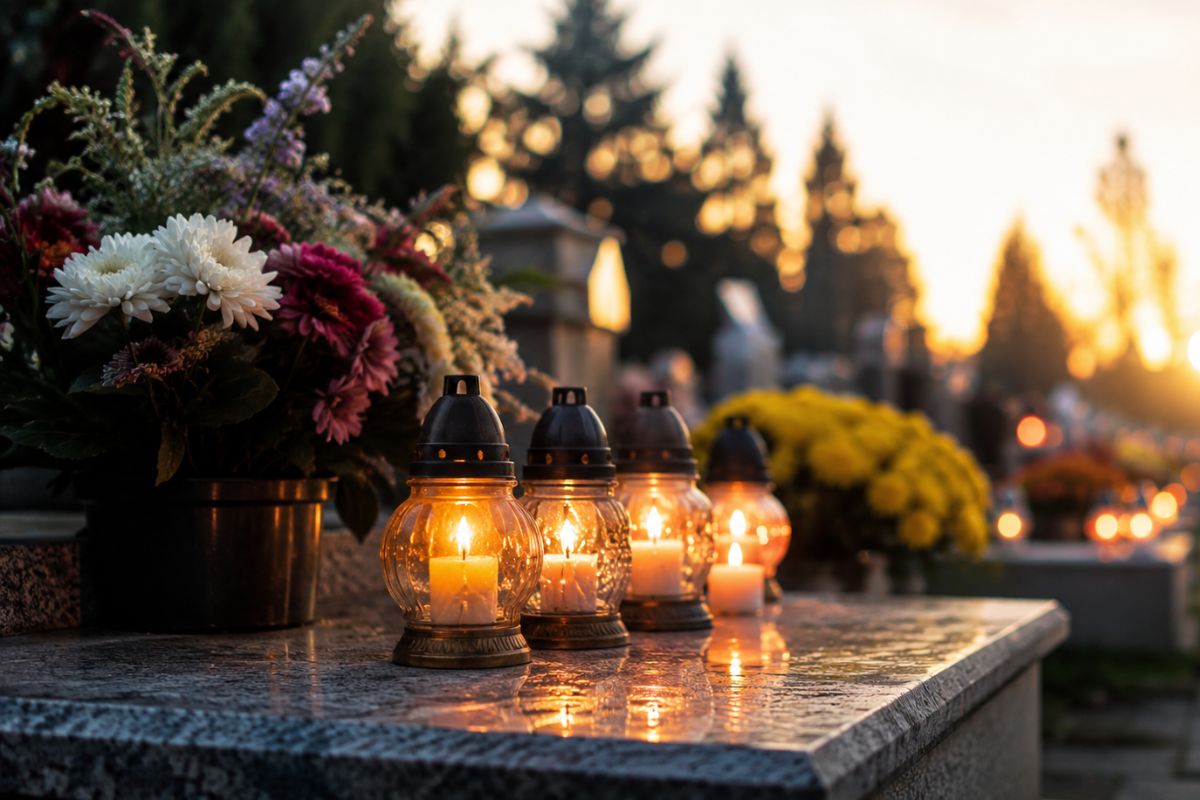
Candles are a symbol that All Saints' Day shares with its Celtic heritage. The Samhain fires lit on the hills to guide spirits have found an echo in Christian candles placed on graves as a sign of prayer and hope.
In some regions of France, and very widely in Poland or Portugal, thousands of candles still illuminate cemeteries on the night of November 1st to 2nd. The sight is striking: the cold stone of the graves, the flickering flames, and something undefinable that resembles collective tenderness.
All Saints' Day in France: a public holiday with a singular history
November 1st is one of the eleven legal public holidays in France. Its status dates back to the Concordat of 1801, signed between Napoleon Bonaparte and Pope Pius VII, which re-established religious holidays in the civil calendar after the revolutionary turmoil.
The 1905 law separating Churches and State maintained this status. Not by religious concession, but by historical inheritance. All Saints' Day is thus one of the rare religious holidays to have crossed French secularism without losing its non-working character.
This public holiday status has had a direct consequence on traditions: it is because November 1st is a non-working day that families can gather to go to the cemetery. The day off amplified and transformed a liturgical practice into a family and popular ritual.
To remember: November 1st has been a public holiday in France for over two centuries. Its anchoring in the country's concordat history explains why All Saints' Day is both a religious holiday and a shared cultural moment, far beyond practicing Catholics alone.
Happy All Saints' Day: how to wish and celebrate?
Can one say "Happy All Saints' Day"? The question often comes up, with some hesitation. The answer is yes: All Saints' Day being a joyful celebration in its spiritual dimension, the wish is entirely legitimate.
However, wishing a "happy holiday" on November 2nd, All Souls' Day, would be less appropriate. The tone there is one of contemplation and remembrance, not celebration.
Some ways to mark November 1st:
- Attend All Saints' Day mass, for practicing Catholics
- Go to the cemetery to lay flowers on graves and reflect
- Gather with family for a meal or shared moment
- Take quiet time to think of those who have passed away
- Transmit to children the memory of ancestors, through stories and photos
For non-believers, All Saints' Day is primarily a day of family memory. The cemetery becomes a place of encounter, transmission, and connection. The meaning changes, but the gesture remains.
FAQ
What is the meaning of All Saints' Day?
All Saints' Day, celebrated every November 1st, is a joyful Christian holiday dedicated to all the saints of the Catholic Church, canonized or not. It reminds us that holiness is accessible to everyone, through various paths. Christians are invited to be inspired by saints as models of faith and love. All Saints' Day also celebrates the "communion of saints," which is the spiritual union between living believers, the deceased, and saints.
What is the difference between All Saints' Day and All Souls' Day?
All Saints' Day (November 1st) honors all saints, known and unknown. The Commemoration of All Faithful Departed (November 2nd), often called All Souls' Day, prays for all ordinary deceased, those who are not canonized saints. The confusion arises from the fact that November 1st, the only public holiday, is used to go to the cemetery, a practice liturgically attached to November 2nd. The two days form a spiritual continuity, but their intentions are distinct.
Why go to the cemetery on All Saints' Day?
Why go to the cemetery on All Saints' Day rather than November 2nd? The reason is essentially practical: November 1st is a public holiday, which allows families to gather without professional constraints. Visiting the cemetery to lay flowers on graves and reflect has thus become a popular tradition rooted in November 1st, even if it liturgically corresponds to the Commemoration of All Souls' Day on November 2nd. For believers and non-believers alike, it is a moment of remembrance, contemplation, and family connection.
What is the origin of the chrysanthemum on All Saints' Day?
The chrysanthemum became the emblematic flower of All Saints' Day for very practical reasons: it flowers in autumn, withstands the cold, and is available in large quantities exactly around November 1st. In the language of flowers, it symbolizes fidelity and immortality. Approximately 25 million pots are sold each year in France on this occasion. Its association with mourning is specifically French: in other cultures, it represents joy and celebration.
What is the relationship between Halloween and All Saints' Day?
The word "Halloween" comes from the English "All Hallows' Eve," literally "the eve of All Saints' Day." The two holidays therefore share the same etymological root and the same date (the night of October 31st preceding November 1st), but their atmospheres and meanings are radically opposite. Halloween is a festive and scary popular holiday, inherited from the Celtic tradition of Samhain. All Saints' Day is a joyful Christian holiday, oriented towards holiness and hope.
Why is All Saints' Day a public holiday in France?
November 1st has been a public holiday in France since the Concordat of 1801, signed between Napoleon Bonaparte and Pope Pius VII, which re-established religious holidays in the civil calendar after the Revolution. The 1905 law separating church and state maintained this status due to historical legacy. November 1st is one of the eleven legal public holidays in France, a status unchanged for over two centuries.