After a death, a sincere condolence gift can take twenty-five different forms: a personalized candle, a memorial piece of jewelry, a plant to be planted, an artisanal basket, an engraved portrait... The right choice depends less on the budget than on the intention, the bond you share with the grieving person, and what they will be going through in the weeks to come. This article details each family of gifts, their nuances, their strengths, and the cases where one is better than another, to help you find without hesitation the gesture that says "I am here."
What gift to give after a death: the essentials to know
Someone you love has just lost a loved one. Words get stuck in your throat. You are looking for a gesture, something concrete to place between the two of you, a way to say "I am here" without having to explain everything. That is exactly what a condolence gift accomplishes: not to console, as no one can truly do that, but to testify to a sincere, lasting, and silent presence if needed.
The question often arises, and it is legitimate: what should one give after a death? The answer does not depend on any particular object. It depends on the intention behind the gesture. A gift chosen with care for a grieving person acts as an anchor. They see it, touch it, and remember that they are not alone.
Four major families of gifts respond to this need, each with its own way of providing support:
- Comforting gifts for daily life: candles, wellness sets, plants, soothing teas. Gentle gestures that lighten the heaviest days.
- Memorial and symbolic gifts: photo frames, memory boxes, commemorative jewelry. Objects that keep the memory alive.
- Natural or spiritual gifts: trees to be planted, eternal roses, artisanal objects. Gestures that inscribe the memory over time.
- Personalized gifts: engraved names, portraits, handwritten text. What transforms an ordinary object into something unique.
Condolence flowers remain a timeless classic. A bouquet delivered the day after the death, an eternal rose that retains the appearance of a natural flower for up to five years: these gestures speak without delay. The sympathy card, however, traverses time differently. A few handwritten words, slipped into an envelope, can be read weeks later when the entourage has gradually moved on.
But sometimes, a significant gesture goes further than a bouquet or a card. A death gift chosen for a grieving family, engraved with a name or a date, says something that standard formulas do not. It says: I have thought of you, of him, of her, specifically. It is this personalization that makes the difference between a generic comfort gesture and an attention that the grieving person keeps for a long time.
No object repairs a loss. But some make it less silent. The following section reviews twenty-five concrete ideas, categorized by type of intention, to help you find, without getting lost, what will best suit your bond, your budget, and the sensitivity of those you want to support.
25 ideas for sincere and appropriate condolence gifts
Choosing a condolence gift is not about finding the perfect object. It is about choosing a fitting intention, one that says "I am thinking of you" without trying to fill the incompressible. Here are 25 concrete ideas, organized by intention, to accompany a grieving person with sincerity.
Comforting gifts for daily life
The first days after a death are often the most disorganized. Gentle attentions, focused on the body and the senses, provide an immediate anchor.
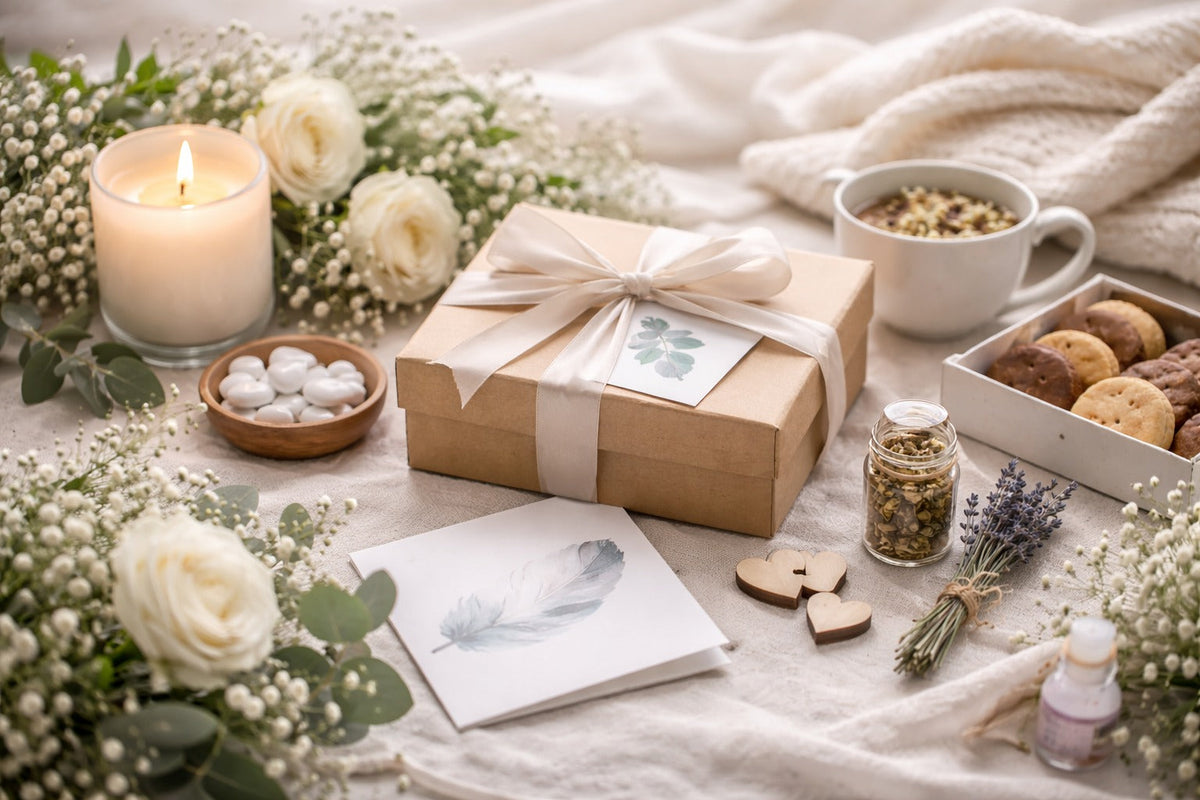
- Wellness set: soothing herbal teas, balm, warm mask. A gesture that says "take care of yourself."
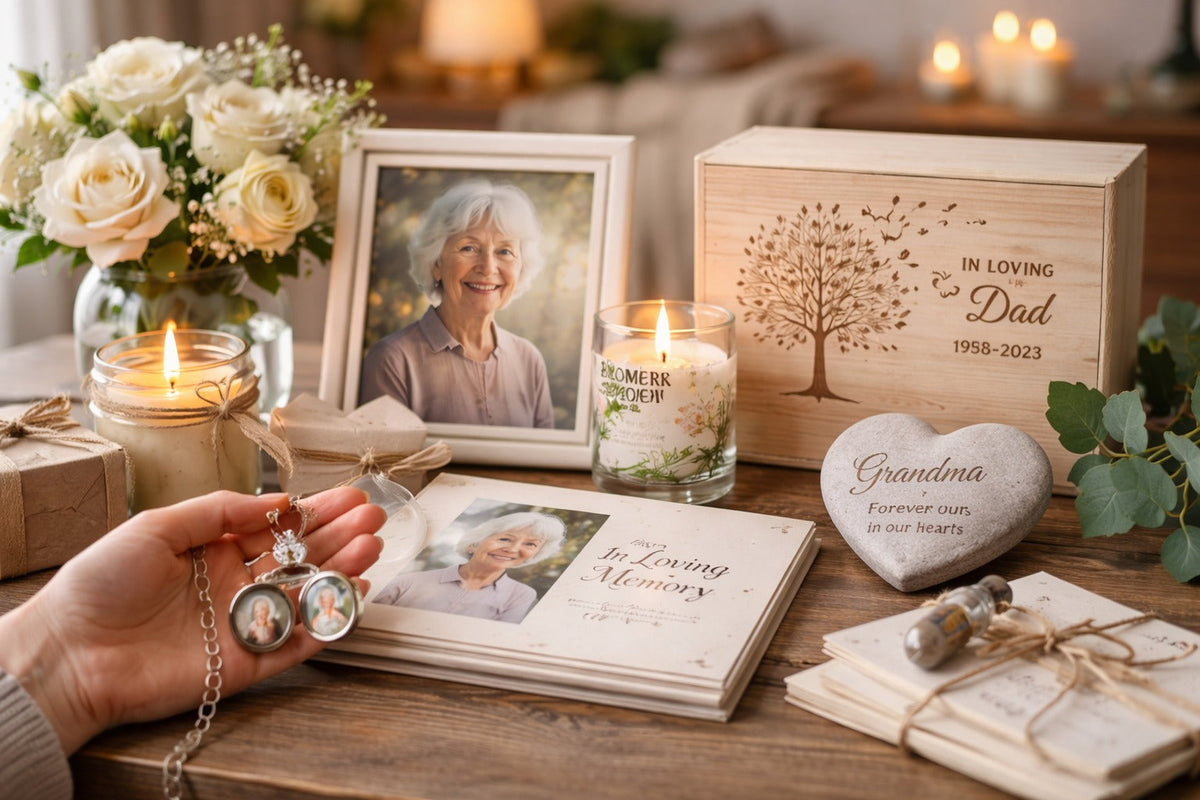
- Personalized scented candle, engraved with a name or date. The memorial candle is lit during moments of reflection.
- Grief gift basket composed of artisanal sweets: chocolates, jam, handmade cookies.
- Notebook or diary to deposit overwhelming thoughts.
- Testimonial book: Vivre le deuil au jour le jour by Christophe Fauré or Traverser le deuil by Sylvie Tenenbaum provide discreet guidance.
- Comforting photo pillow, soft to the touch, printed with a portrait of the deceased.
Memorial and symbolic gifts
These objects honor the memory. They last, are displayed, and are worn. Far from ephemeral flowers, they traverse time.
- Photo frame personalized with an engraved quote or date.
- Personalized memory box to collect letters, photos, and cherished objects.
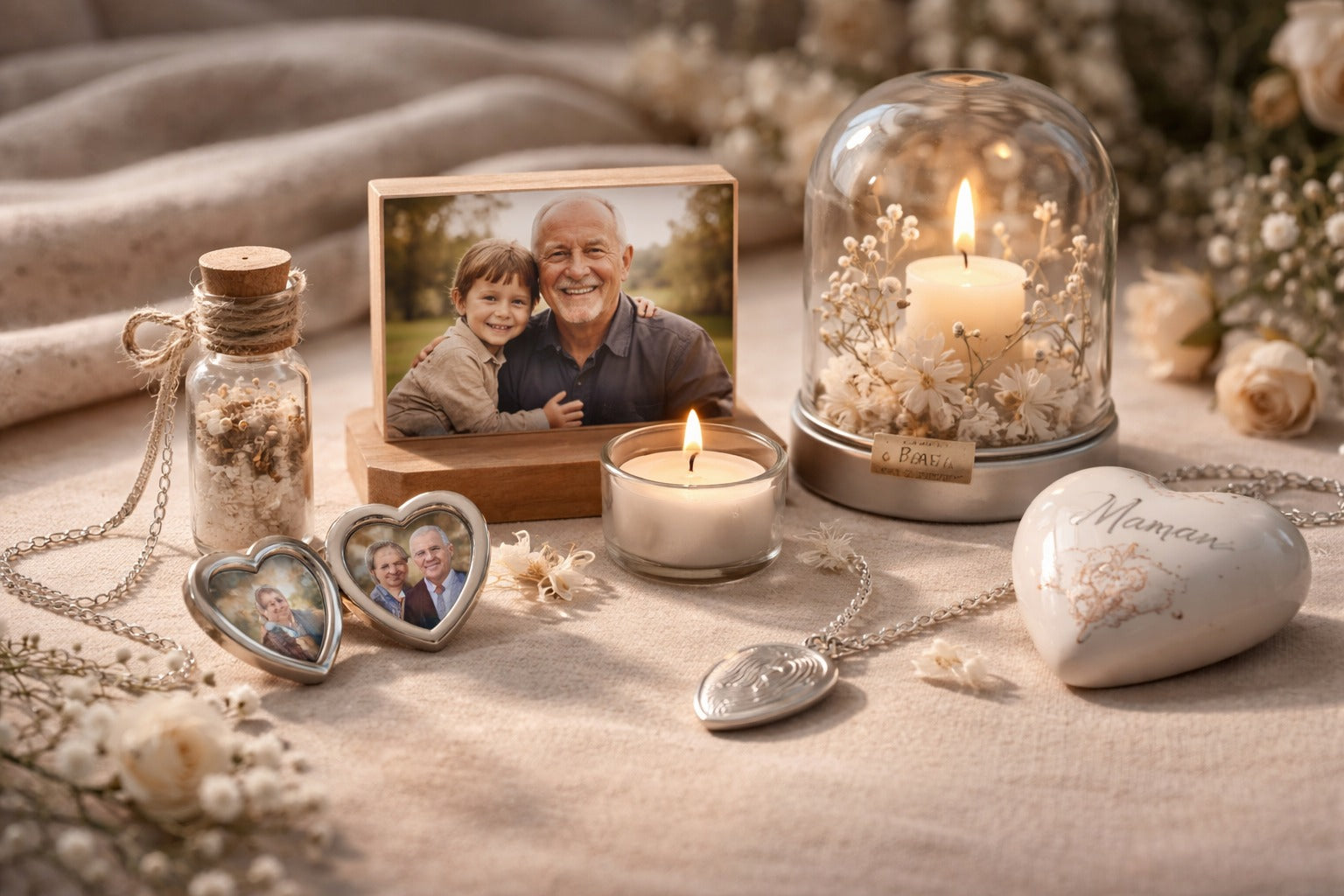
- Commemorative jewelry: bracelet engraved with initials or a pendant, worn as a talisman.
- Ceramic tile with portrait, to be placed on a desk or shelf.
- Personalized teddy bear, particularly appropriate during the grief of a child.
- Wooden stand with glass candle holder, recommended after a cremation to create an atmosphere of reflection.
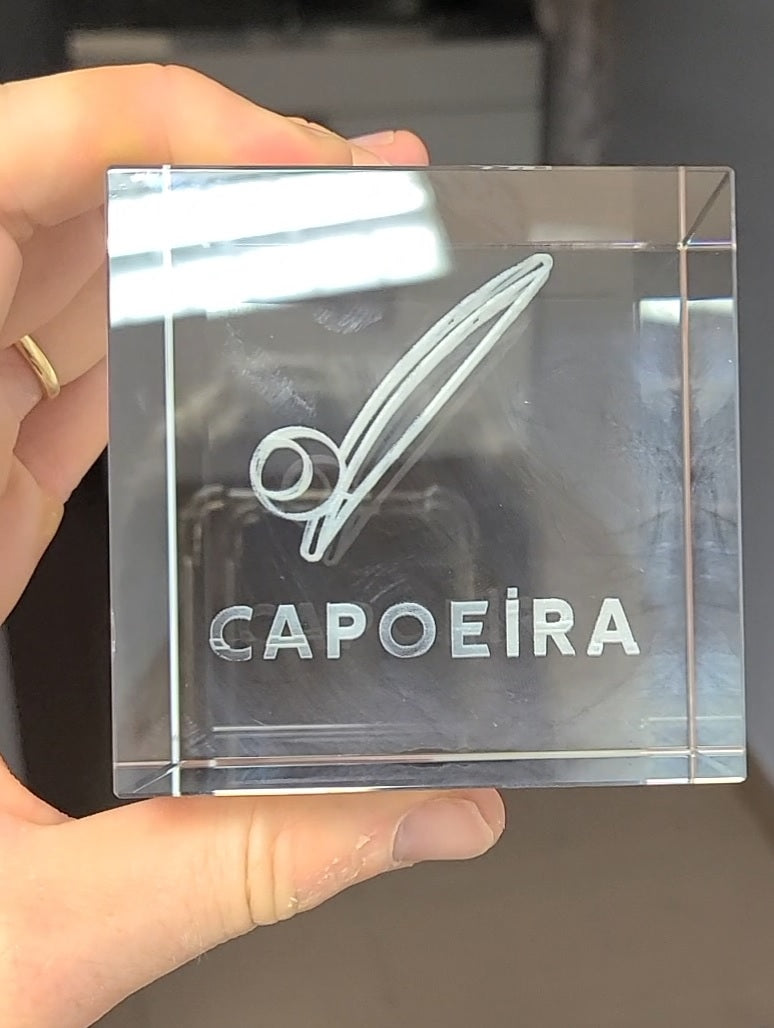
And then, there is the crystalline digraph. In a block of glass crafted in France, two names merge into a single optical illusion: depending on the angle of view, one emerges, the other waits. This is not an object you look at once. It is a memory of the deceased that reveals itself in each different light, at every hour of the day. A personalized tribute gift that honors two presences in the same reflection.
Natural or spiritual gifts
Nature speaks of the cycle. These gifts speak of continuity, of life that resumes despite everything.
- Easy-to-maintain green plant: a ficus, a pothos, a white orchid.
- Bag of seeds to sow in the garden, in tribute to the deceased.
- Tribute tree planted in a partner forest, with a nominative certificate.
- Eternal rose, which retains the appearance of a natural rose for up to 5 years.
- Incense sticks or essential oil diffuser to ritualize moments of silence.
Gifts to facilitate daily life
Grief is exhausting. Some attentions do not need to be symbolic to be profound.
- Home meal delivery over several days: a concrete, immediate help, without embarrassment.
- Participatory fundraising to cover unforeseen funeral costs.
- Offer of housekeeping or childcare for a week.
- Gift card for a local grocery store or pharmacy.
- Subscription to an online meditation or psychological support service.
Whatever form is chosen, it is the intention behind the gesture that counts. The rest of this article helps you refine this choice according to the relationship and the timing of the grief.
How to choose the right gift according to the relationship and the timing of the grief
There is no universal condolence gift. What touches a close friend will leave a colleague puzzled. What soothes the day after a death is not what provides support three months later. Three parameters truly guide the choice: the relationship, the timing, and the nature of the loss.
According to the relationship with the grieving person
To support a grieving friend, closeness allows for a more intimate gesture. A gift for a grieving friend benefits from being personalized: an object engraved with the name of the departed loved one, a book like Vivre le deuil au jour le jour by Christophe Fauré, or a concrete presence, cooking, accompanying to an appointment, sitting without saying anything. The value is not in the price. It is in the precision of the gesture.
With a colleague, the professional distance imposes a different approach. A sincere card, handwritten, with two or three sentences that name the loss without minimizing it, often says more than an object chosen in a hurry. A sober gesture, respectful of the professional framework, remains the most fitting.
For a distant family member, sending a sincere gift by mail, a memorial candle, a green plant, or a discreet condolence gift signals a benevolent presence without imposing oneself on an intimacy to which one does not belong.
According to the timing of the grief
- Just after the death: the urgency is not symbolic, it is practical. A prepared meal, logistical help, a short message without expectation of a reply.
- A few weeks later: this is often when the entourage becomes rare and loneliness sets in. An object that honors the memory of the deceased, sent without a particular occasion, reaches the grieving person at a time when they do not expect it.
- On an anniversary date: the first anniversary of the death, the birth date of the departed loved one. A simple message or a souvenir of the deceased slipped into an envelope shows that you have not forgotten.
According to the nature of the loss
The loss of an elderly parent, often anticipated, calls for gentle and lasting support in grief. A sudden or accidental death requires, on the other hand, physical presence more than an object.
The loss of a child or a baby condolence gift requires a particularly gentle and non-intrusive attention. Nothing imposing, nothing too bright: a small candle, a notebook to write in, a gesture that recognizes the reality of that child without reducing them to an absence. Discretion, here, is a form of respect.
Is it mandatory to give a gift after a death?
No. The gift is not an obligation. Some grieving people prefer silence to any object. But a benevolent gesture, chosen with honesty, sometimes lightens what words cannot traverse. Emotional support rarely comes through the object itself; it comes through the intention it carries.
Gifts to avoid and common mistakes not to make
Choosing a condolence gift requires real vigilance. Some attentions, even if offered with sincerity, miss their target and create discomfort where they intended to bring comfort. Here are the most common mistakes, without judgment, to better avoid them.
Gifts that clash with the context
A gift that is too joyful, too festive, or too colorful sends a discordant signal to a grieving person. Balloons, confetti, sparkling packaging: these visual codes belong to celebrations. They do not accord with the gravity of a loss. An inappropriate gift in a context of grief is not bad in itself. It simply arrives at the wrong time, in the wrong form.
Same logic for utilitarian gifts offered without a message: a kitchen set, a gift voucher slipped into an empty envelope, a functional object without an accompanying note. These gestures signal embarrassment rather than support. The intention disappears behind the impersonal.
Clumsiness related to flowers and symbols
Offering flowers to a grieving person remains a classic gesture, but it carries a risk that is often underestimated: flowers wither quickly. Sent several days after the death, they arrive already weakened and remind, in spite of themselves, of the temporality of the loss. The chrysanthemum is described as the funeral flower par excellence in France, which makes it appropriate for funerals, but delicate outside of that specific framework.
Conversely, gifts that highlight death too explicitly, unwanted decorative urns, objects bearing heavy epitaphs, can be hurtful. Modesty, here, protects.
Mistakes in the condolence card
The card is often the first reflex. It is also where the clumsiness of phrasing does the most damage. A few sentences to absolutely avoid:
- "I know how you feel": every grief is unique, no one feels exactly the same.
- "They are in a better place": this formula, even if well-intentioned, can be hurtful depending on the person's convictions.
- "Stay strong, you'll get over it": it minimizes a pain that deserves to be recognized, not relativized.
- Leaving the card blank or writing a single generic line: it is almost worse than sending nothing at all.
What changes everything? A few handwritten, personalized lines that mention the deceased by their first name or evoke a shared memory. This detail makes the difference between an administrative gesture and true accompaniment in grief.
What really makes the difference
A personalized object accompanied by a sincere note is worth infinitely more than an attentive but anonymous gift. Personalization transforms the object: it bears a name, a date, a story. It says "I thought of you, not an abstract grieving person." It is this level of intention that makes a gesture of comfort a true lasting emotional support, not the object itself.
Honoring the memory of a loved one: when the gift becomes a lasting tribute
Some gifts last only a short time. Others span the years, placed on a shelf, worn against the skin, reopened during moments of loneliness. Those objects are part of a separate category: they do not relieve the pain, but they keep the presence of the one who has left alive. This is what is called a tribute gift.
Honoring the memory of a departed loved one is accepting that the memory deserves a concrete space in daily life. Not a frozen relic. A living object, which one looks at, touches, and which still speaks the name of someone.
Among the most lasting forms of tribute, the crystalline digraph occupies a singular place. Crafted artisanally in France, it unites two names in a glass optical illusion: depending on the angle of view, one appears, then the other emerges gently. The name of the deceased and that of a loved one merge in a single work, like two presences that respond to each other without ever fading. The glass captures the light, deflects it, invites it to play. This commemorative gift thus becomes a personalized souvenir object that the family keeps for years, long after the flowers have withered.
Other forms of lasting tribute deserve to be considered:
- The memory box: it gathers handwritten letters, photos, small everyday objects. It gives the grieving person a place to deposit their memory, at their own pace.
- The engraved commemorative jewelry: bracelet or pendant bearing a name, date, initial. Worn daily, it keeps the bond visible.
- The personalized photo frame: sober, elegant, it transforms an image into a tribute piece, suitable for any interior.
These gestures share the same intention: not to let absence settle into silence. A personalized tribute gift says something that standard condolences do not always formulate: "this person mattered, and they still matter."
Honoring someone is not about erasing the pain. Nor is it about pretending that time fixes everything. It is rather about placing a light in a dark place, and letting it burn gently, for a long time. A name engraved in glass. A box that one doesn't open every day, but which one knows is there. A piece of jewelry one clutches between fingers on certain mornings.
These objects replace no one. They keep a trace. And sometimes, that is exactly what a grieving family needs: not to forget, but to know where to look to find, for a brief moment, that beloved face.
FAQ
What gift to give to a grieving person?
An object that says "I am thinking of you" without trying to console what cannot be consoled. Scented candle, plant, commemorative jewelry, photo frame, or personalized digraph with the name of the departed: what matters is that the gesture is chosen for that specific person, not picked at random from a shelf.
What gift to give to express condolences?
Anything that testifies to a lasting presence: a handwritten card to be reread weeks later, flowers delivered promptly, or a personalized object engraved with a name or date. A commemorative gift, memory box, or digraph keeps the memory alive long after the entourage has moved on.
What gifts should be avoided after a death?
Objects that are too joyful, festive, or mismatched with the moment. A generic gift, with no link to the person or the deceased, can seem indifferent. Also avoid anything that requires an effort from the recipient: subscription to manage, activity to plan. Grief calls for gentle gestures, not additional obligations.
Which condolence gift to choose when you don't know what to do?
Start with a simple gesture: a handwritten card and a comforting object for daily life. If you want to go further, a personalized gift, engraved with the name of the departed, says something that no standard formula says. It is often this type of object that the family keeps the longest.
A sympathy gift: the gesture that remains when words fade away
No object can replace one’s presence, and no one claims otherwise. But a thoughtfully chosen sympathy gift—whether engraved with a name, scented like a candle lit in silence, or planted in a garden to weather the seasons—says something that standard phrases cannot. It says that the loss has been seen, heard, and acknowledged. Over time, personalized tokens tend to take on even greater meaning: a piece of jewelry worn for years, a frame looked at every morning. An ephemeral gesture offers comfort on the first night. A lasting object, however, accompanies the journey.