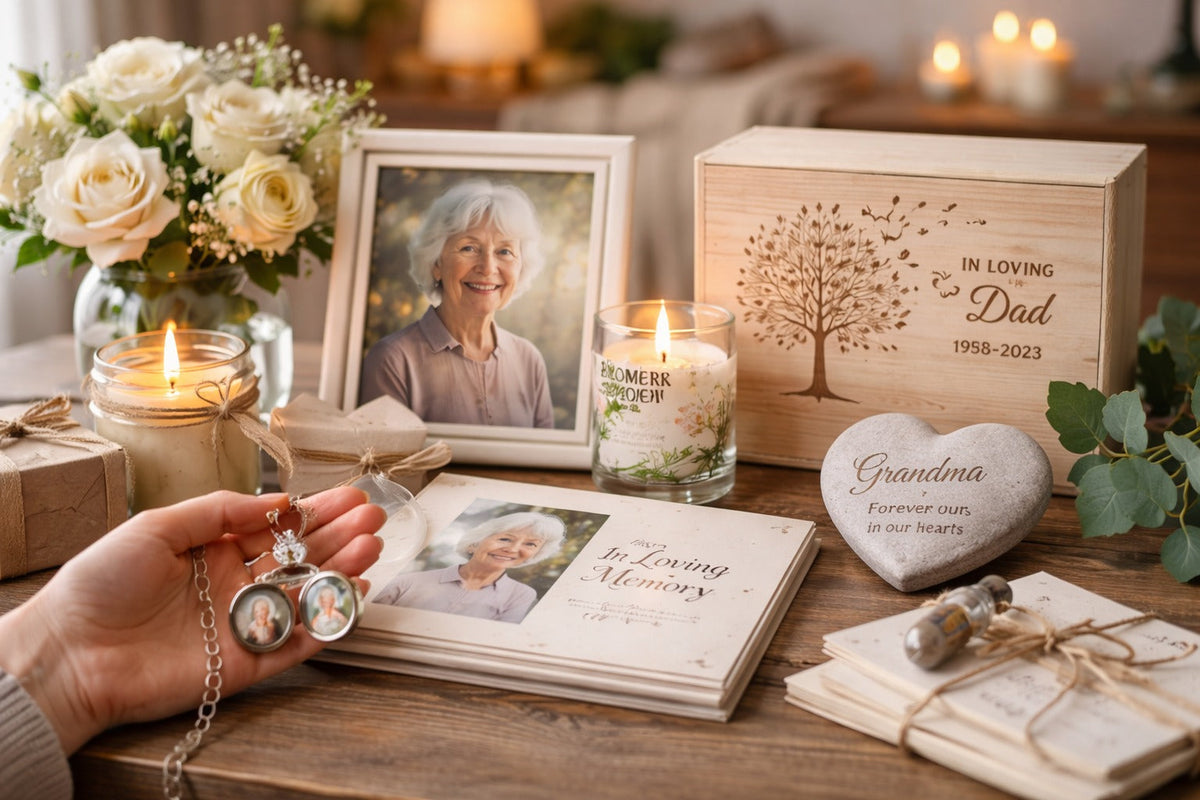
When facing grief, six families of personalized items truly make a difference: engraved jewelry, photo on wood, memory book, memorial candle, keepsake box, and decorative objects like a crystalline digraph uniting two names in the light. These gifts last where flowers fade, because they carry a name, a date, a concrete trace of the bond experienced. This article details each path, its nuances, and what makes each one right according to the relationship shared with the departed person.
What personalized gift should you offer after a death?
Words get stuck in the throat. You look for the right gesture, the right distance, the right way to say "I am here" without being awkward. And often, you find yourself empty-handed in front of a bouquet of flowers that will wither in three days. A personalized gift after a death profoundly changes this equation: it is not a gesture of politeness, it is a presence that lasts.
The period of mourning does not stop the day after the funeral. The real loneliness begins when everyone has returned home. That is when an object chosen with care takes on its full value. Not to fill the void—nothing does that. But to keep a light on, like a gentle reminder that the departed person truly existed, truly mattered, and truly left a trace.
The best mourning gift is never generic. It bears a name, a date, a silent voice engraved in matter. Those who receive these condolence gifts keep them for years. Some place them on a shelf and look at them in the morning. Others slip them into a pocket and touch them without thinking. This discreet, almost physical emotional support cannot be provided by ephemeral flowers.
So, what should you choose concretely? Several families of objects answer this question, each in their own way:
- Memorial jewelry, worn close to the body, which sometimes holds an engraving or a small amount of the deceased loved one's ashes
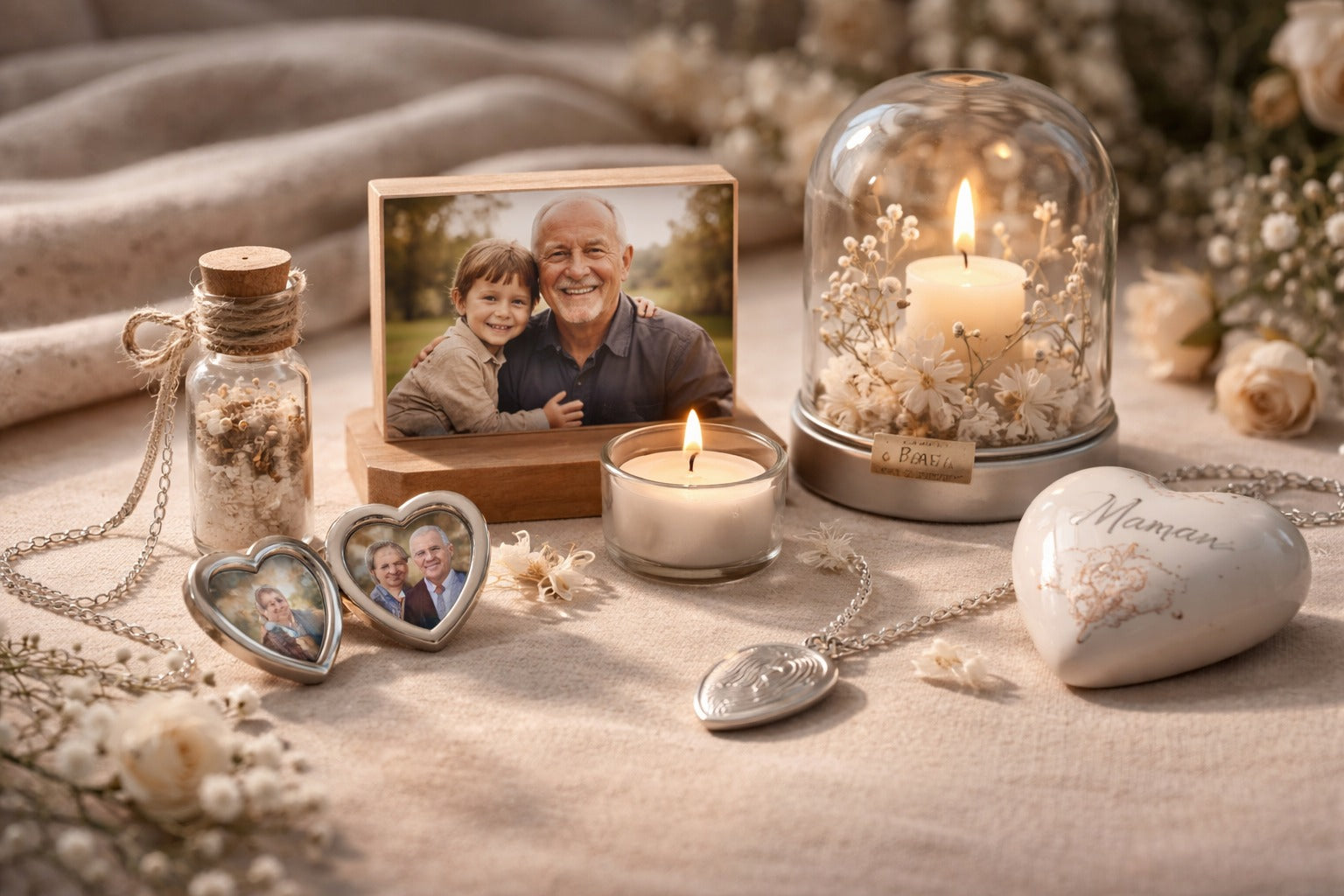
- A personalized photo frame or photo on wood, which brings a beloved face into everyday life
- A memory book, which gathers images, words, and anecdotes into a single transmissible legacy
- A memorial candle, engraved with a quote or a name, which turns every lighting into a ritual
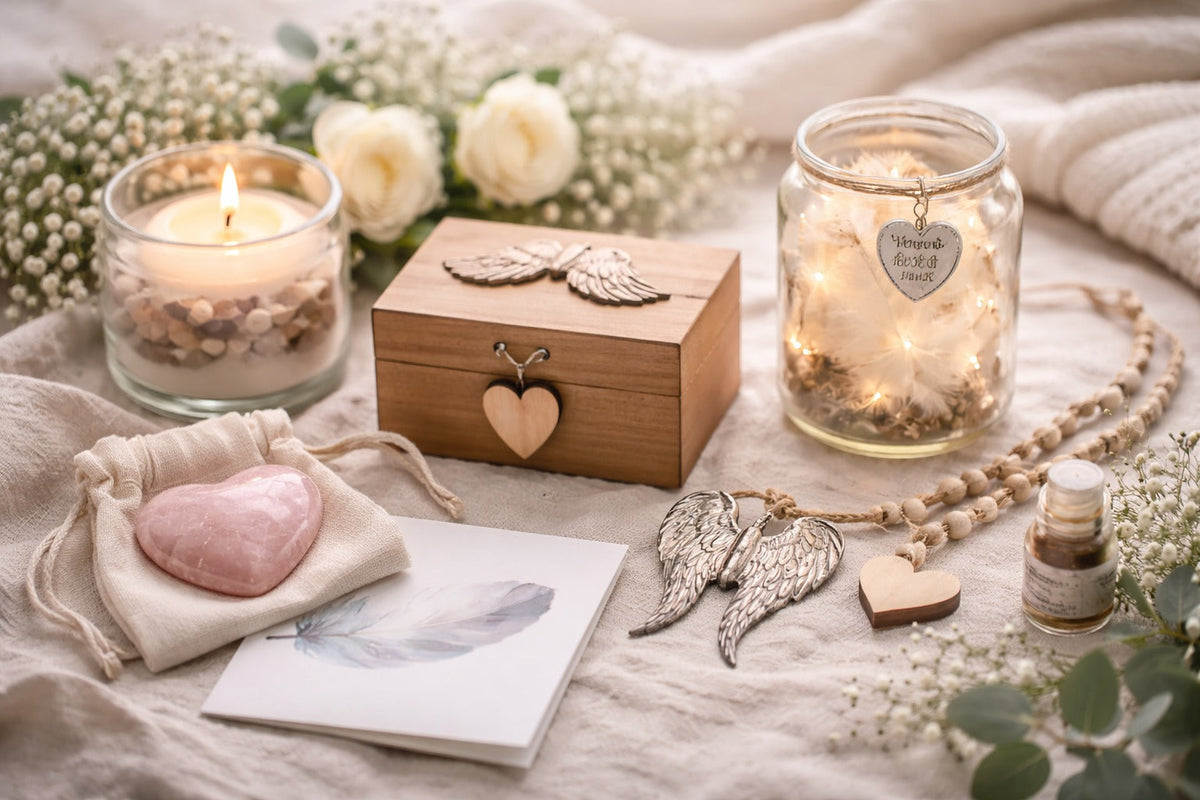
- A personalized keepsake box, a discreet case for small, emotionally charged items
- A personalized decorative object, such as a crystalline digraph where two names merge in the light
What distinguishes a truly touching bereavement keepsake from a simple symbolic gift is its grounding in the real bond. The deceased's first name. The birth date, not the death date. A phrase he or she often repeated. These details transform an ordinary object into something irreplaceable for the grieving person.
A sincere gesture cannot be improvised. It requires some time, some listening, and the willingness to give something no one else would have thought to choose. The following chapters detail each idea to help you find the one that resembles the bond you shared with the deceased person.
7 personalized memorial gift ideas, from the intimate to the unexpected
A personalized memorial object is not a simple present. It is a silent guardian. It remains there when loved ones have left, when the funeral is over, when daily life resumes despite everything. Here are seven ideas to honor the memory of a deceased person with sincerity.
-
Engraved memorial jewelry
A name chiseled on a pendant. A date engraved inside a bracelet. Some memorial jewelry even holds a small amount of the deceased's ashes, turning the metal into a discreet relic. Worn daily, it maintains a constant presence, without imposing anything on the eyes of others.
-
A personalized photo frame or photo on wood
The natural warmth of wood changes everything. A souvenir photo printed on wood is unlike any other: the veins of the material run through the image, giving it a living depth. Placed on a shelf or desk, it settles in without being imposing, and remains.
-
A memory book or photo album
Flipping through a memory book is like finding voices. Trips. Forgotten fits of laughter. Gathering photos and words from loved ones in one volume creates a legacy that future generations will be able to hold in their hands.
-
A memorial candle with a message or quote
Lighting a memorial candle on the evening of an anniversary is a ritual gesture of absolute simplicity. Engraved with a chosen quote or a name, it turns darkness into presence. Light does what words do not always know how to do.
-
A personalized keepsake box
A folded letter, a movie ticket, a small stone picked up together: tiny things are often the ones that weigh the heaviest. A personalized keepsake box, engraved with the deceased's name or a date, gives these fragments of existence a space worthy of them.
-
A handwritten sympathy card in an object
Slipped into a frame, sewn into an embroidered pouch, or locked in a wooden box, a handwritten sympathy card takes on another dimension. The right word, traced in ink, crosses time in a way that digital messages cannot reach. The grieving family sometimes pulls it out years later.
-
The crystalline digraph
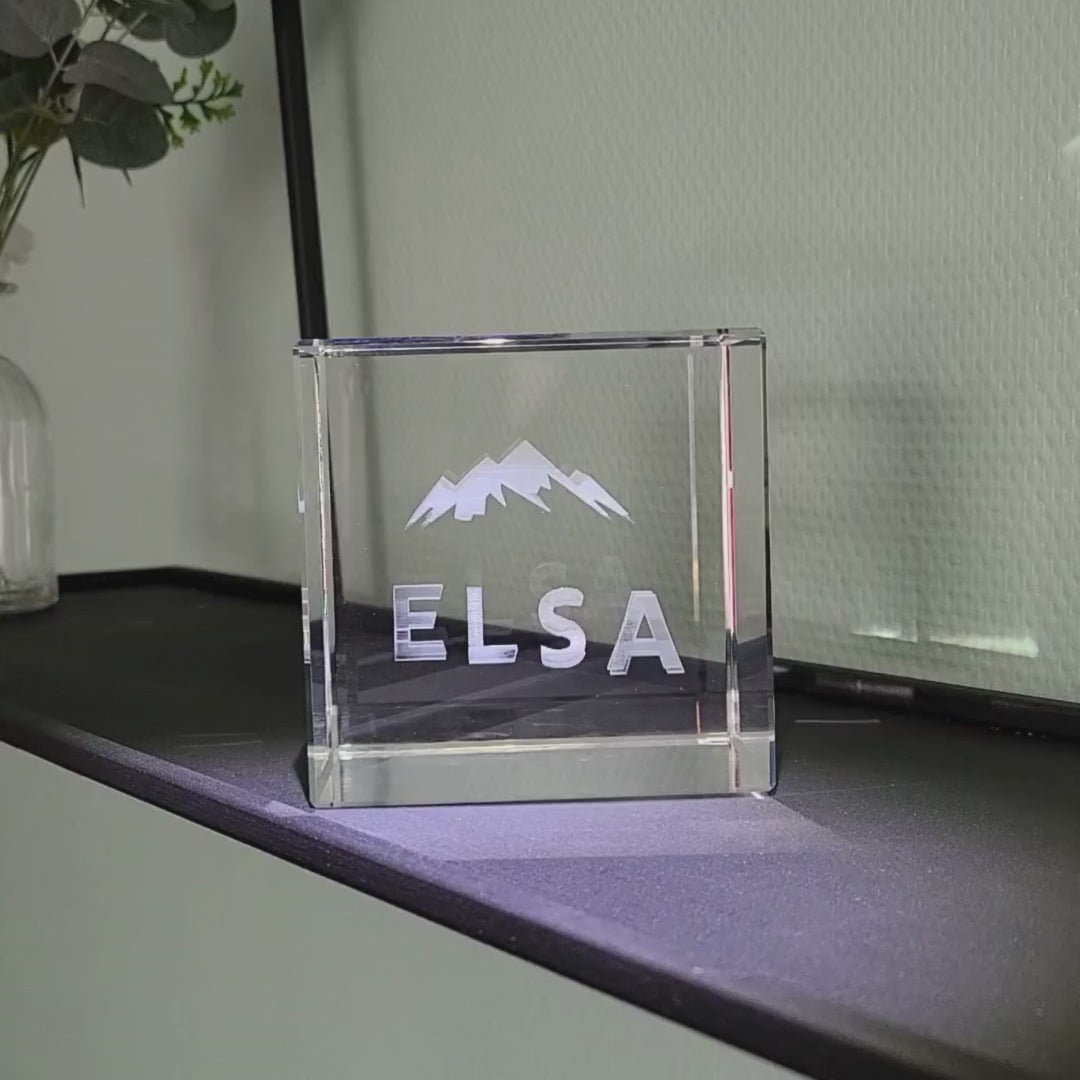
This is the most unexpected idea. A crystalline digraph is an optical illusion made in France: two names merge into a single crystal object, one visible from one angle, the other from another. Depending on the light and the gaze, one or the other appears. One name can be that of the departed, the other that of the grieving person. It is not a frame or a piece of jewelry. It is something else, a symbolic object that plays with transparency to keep two presences in one.
These ideas range from the intimate to the poetic. Each follows a different logic: what matters is that the chosen object truly resonates with the bond that existed between the grieving person and the deceased. A touching keepsake is not improvised; it is chosen.
The crystalline digraph: when light keeps a presence
Among all the objects one can choose after a death, the crystalline digraph holds a special place. Not just because it is beautiful. Because it does something strange and moving at the same time: it holds two names in a single block of crystal, visible one after the other depending on the angle of view.
It is an optical illusion. But an illusion that tells the truth.
Look at the object from the front: one name appears. Tilt your head slightly, shift your gaze: the other emerges, as if from nowhere. One fades, the other returns. In this silent dance between light and the transparency of crystal, two names engraved in the material seem to be waiting for each other.
In the context of mourning, this logic takes on a particular depth. The name of the departed loved one does not disappear: it waits for its time, hidden in the reflection. The grieving person knows it is there, always, even when the gaze moves away. This is perhaps the most accurate definition of memory: a symbolic presence that we find every time we take the time to truly look.
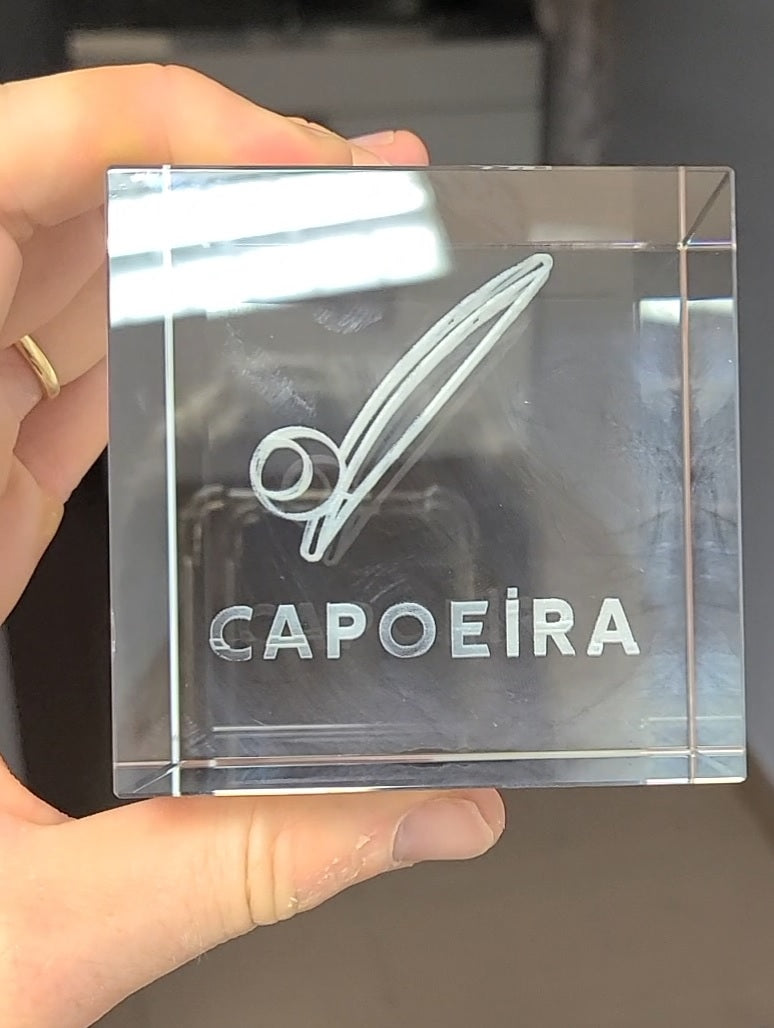
The crystalline digraph is handcrafted in France. Each piece is born from a personalized laser engraving, designed for the names, dates, or messages chosen by the person ordering. The transparency of the crystal is not an aesthetic detail: it works as a metaphor. What is engraved in the material remains visible through it, without ever being drowned in it. The light passes through, reveals, plays. This brilliance reminds us that memory, too, has its own reflections.
What makes this souvenir object particularly suitable for mourning is that it does not plunge into sadness. It does not commemorate the loss. It celebrates the bond, making it persist in a concrete form, to place on a shelf, to contemplate on a November morning or an anniversary. A memorial gift that travels through time without aging, without fading.
The customization goes deep: names chosen with care, date of birth or death, short message engraved in the base or in the crystal itself. The attention paid to these details transforms a decorative object into a unique and touching keepsake.
- Two names engraved in the crystal, visible depending on the viewing angle
- Handcrafted in France, personalized laser engraving
- Customization possible: names, dates, short message
- Transparent crystal, natural brilliance, durable symbolic object
What if the most beautiful gift after a death were not the one you see right away, but the one that reveals something with every new look?
How to properly choose a personalized gift for a grieving person?
Before looking for a keepsake object, ask yourself a simple question: what bond united this person with the deceased? This is not a detail. It is the starting point of everything.
A spouse who has lost their life partner does not wait for the same comfort as a childhood friend or a parent who has lost their child. For the spouse, an object engraved with both names touches something intimate and permanent, almost carnal. For a parent, it is often an image, a date, a voice that one seeks to keep. For a friend, the memorial gift can take a lighter form, anchored in a shared memory rather than in the mourning itself. Adapting to the bond with the deceased means refusing the generic gift. It means choosing with intention.
The personality of the grieving person matters as much as the bond. Some go through this period in the strictest privacy: they do not hang photos on the wall, they do not willingly talk about their loss. For them, a discreet object, worn on the body or placed in a drawer, is more appropriate than a large decorative piece. Others, on the contrary, keep a photo visible, light a candle every night, and make memory a daily gesture. These people will welcome a visible object with gratitude. Observe. Listen. That is often enough to guide your choice.
Beliefs and cultural sensitivities are also worth considering. An object too charged with religious symbols may make a grieving family who does not adhere to them uncomfortable. Conversely, a gift that is too neutral may seem cold, almost indifferent. The right balance comes from knowing the deceased and their family: their habits, their relationship with death, what they find beautiful or soothing.
And the timing, in all of this? Condolence gifts often arrive in droves right after the funeral, in the first days of shock. The grieving family is surrounded, overwhelmed, sometimes absent from themselves. An object received three or four weeks later says something else: "I am still thinking of you." That message, precisely because it arrives when silence has settled in, often touches more deeply than any sincere gesture from the day after the ceremony.
Some markers to guide your choice:
- Reflect on the bond between the recipient and the departed before thinking about the object itself.
- Prefer a discreet gift for people who live their mourning in withdrawal, a visible object for those who make memory a daily landmark.
- Check that the object does not create tension with the family's religious or cultural beliefs.
- Consider waiting a few weeks after the funeral: the surprise of a loved one who is still thinking of them often does more good.
Choosing a memorial gift is ultimately an act of listening. The object comes after. It confirms what you have understood about the bond, the pain, and what is missing the most.
Frequently asked questions about personalized mourning gifts
What gift should you choose after a death?
The question comes up often, and it deserves an honest answer: there is no universal gift for mourning. What matters is the grounding in the bond. A piece of jewelry engraved with the deceased's name, a photo on wood taken from a shared memory, a memorial candle with a carefully chosen quote, a personalized keepsake box... each of these objects carries an intention that one does not find in a standard present. And for those who wish for something truly out of the ordinary, the crystalline digraph offers a rare form: two names merged in glass, revealed by the light depending on the angle of view. A memory of a departed loved one that is like nothing else.
What makes a gift truly symbolic?
A symbolic gift does not speak only of the absence. It speaks of the bond. That is the whole difference.
A piece of jewelry engraved with the deceased's name is worn close to the body. A wood photo reproduces a face, a light, a moment. A light object like a candle or a crystal piece passes through the gloom and reminds us that memory does not fade. These personalized condolence gifts work because they name someone specific, anchor a memory in matter, and travel through time without degrading. It is not the beauty of the object that comforts; it is its capacity to say: this person existed, and their bond with you too.
What funeral gift ideas actually exist?
The word "funeral" is often intimidating. It evokes coldness, formality, frozen sadness. But a memorial gift can be luminous, poetic, even carry hope.
Personalized gift ideas for a mourning period are more varied than one might think:
- an illustrated portrait of the deceased, gentle and soothing to look at
- a memory book gathering photos, anecdotes, and messages from loved ones
- a piece of memorial jewelry, sometimes designed to hold a small amount of ashes
- a photo on wood, warm and natural, to place in a living area
- a crystalline digraph, where the deceased's name emerges in the glass according to the light
None of these objects locks mourning into sadness. Each, in its own way, keeps something alive. Comfort does not come from a perfect object; it comes from a right object.
Taking the time to choose, personalizing with what truly belongs to this history, and entrusting this object to the grieving person: that is perhaps the most sincere gesture one can make.
FAQ
What personalized gift should you choose after a death?
The best gift carries a real trace: an engraved name, a date, a phrase. Memorial jewelry, photo on wood, memory book, engraved candle, or personalized decorative object like a crystalline digraph—each keeps the memory of a departed loved one alive, well after the funeral, when the loneliness truly sets in.
What is an appropriate symbolic gift to accompany a death?
A symbolic mourning gift anchors a memory in matter. It does not fill anything, but gently reminds us that the departed person existed, mattered, and left a trace. The more it carries intimate details, a nickname, a birth date, a quote, the more irreplaceable it becomes for the person who receives it.
What memorial gift ideas exist to honor a deceased person?
Several objects meet this need: engraved jewelry, personalized photo frame, memory book, memorial candle, keepsake box, or personalized decorative object. At Digraphe, the crystalline digraph also allows for merging two names in the light, a visual and poetic tribute, discreet to look at, strong to feel.
Is it better to offer flowers or a durable gift after a death?
Flowers fade in a few days. A personalized object remains on a shelf for years, slipped into a pocket, looked at in the morning. It is not a question of material value: it is a presence that lasts, where flowers stop at the threshold of the funeral.
When is it appropriate to send a sympathy gift?
Around the funeral, of course, but not only then. Real loneliness begins afterward, when the entourage has returned home. A gift received a few weeks later, or on the deceased's birthday, can hit the mark even better. Timing matters as much as the object itself.
A personalized gift after a death, so that memory stays alive
Jewelry, wood, crystal, candlelight, or the pages of a memory book: a personalized gift after a death does not erase anything; it keeps something lit. An engraved name, a carefully chosen date, an object the hand finds without thinking. That is what distinguishes an ordinary gesture from one that remains. And perhaps the next question is no longer "what to give" but "what trace of this bond deserves to exist in physical form, long after the words have fallen silent."