When faced with the loss of a loved one, two main types of gifts stand out: everyday items that ease the burden of difficult days, and symbolic gifts that keep the memory of the deceased alive. The latter, engraved with a name or date, endure long after others have faded. This article explains how to choose between these two approaches, which items to consider depending on the relationship and the timing, and why a carefully chosen symbolic bereavement gift becomes a silent, lasting presence long after the funeral. These insights complement those offered by a gift to support someone through grief in general.
Bereavement gift: what to give (and what it says about you)
Someone you love has just lost a loved one. Words fail. You are looking for a gesture, something tangible, appropriate, and sincere. A symbolic bereavement gift does not erase the loss. It says something else: “I haven’t forgotten. I am here.”
This is the first question everyone asks, and the hardest to answer: what should you really give someone who is grieving? The answer lies less in the object itself than in what it represents.
There are two main types of gifts. They speak very different languages.
- Gifts that offer daily comfort: a soft blanket, a hamper of herbal teas, a scented candle, a carefully prepared meal. These practical gestures ease the burden of difficult days. They say “I am thinking of you” without requiring a response.
- Gifts that honor the memory of the deceased: an engraved item, a memorial piece of jewelry, a personalized creation bearing the deceased’s name. These symbolic gifts maintain a living connection between the bereaved person and the one they have lost.
These two types of gifts are not mutually exclusive. But they carry different emotional weight. A comforting bereavement gift eases the body and mind in the moment. A symbolic gift, however, endures. It remains on a shelf, in a pocket, or close to the skin. It becomes a silent presence.
This is where the choice matters. What you choose to give reveals what you want to convey. Are you trying to ease their pain? Or to acknowledge that the person who died deserves to be kept alive in memory?
Supporting someone who is grieving is not about offering them a way out of their sorrow. Grief is not a chapter to be closed. It is a slow, unique journey that requires presence without intrusion. A gift after a death says exactly that: I am here, and I haven’t forgotten.
The value of the gesture is not measured by its price. A notebook for recording memories, a plant to nurture, a personalized item with an engraved date or name: these thoughtful gifts often touch more deeply than an expensive gift chosen in haste.
How can you choose without making a mistake? Before buying, ask yourself just one question: does this item honor what was, or does it try to make it seem as though nothing happened? The right condolence gift does not replace time. It offers support.
Emotional support during grief takes many forms. An object is just one of them. But when chosen with intention, it becomes an act of remembrance.
Symbolic gift ideas to honor the memory of the deceased
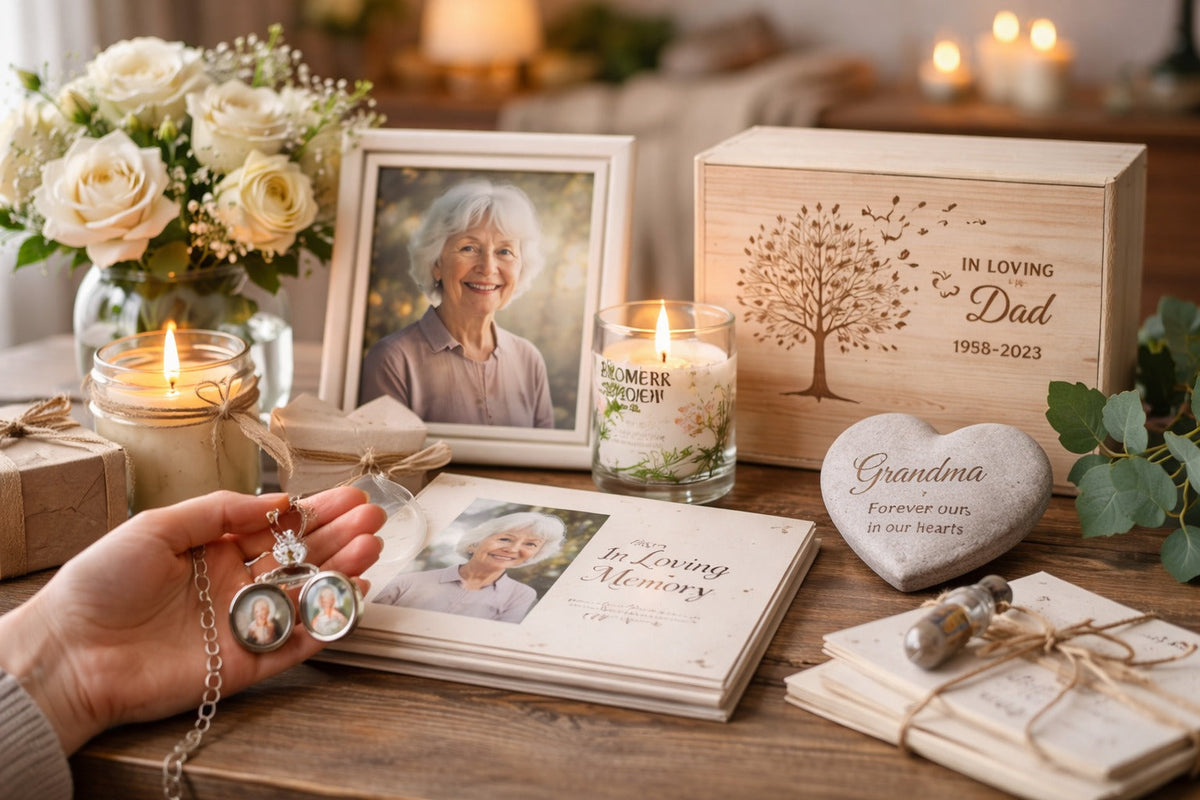
A carefully chosen item does not offer comfort. It bears witness. It says, without words, that the person who died remains present, remembered, and loved. This is what separates an ordinary gift from a true memorial gift: personalization, which transforms an object into a memory. The same principle applies to a gift in honor of the deceased, where every gesture is an expression of respect.
Items to wear: memorial jewelry and personalized engraving
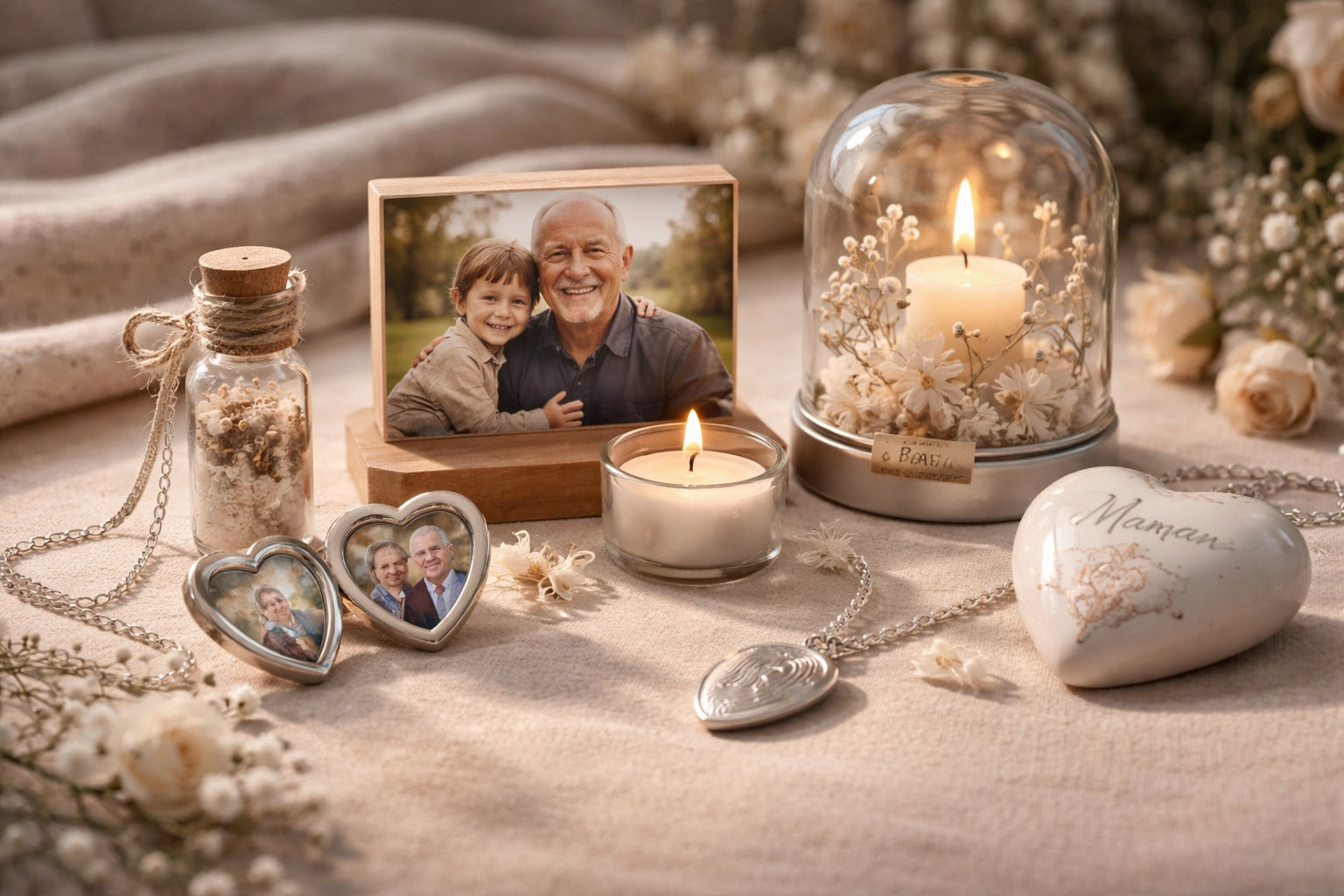
Memorial jewelry is one of the most intimate ways to keep a memory alive. A pendant engraved with the deceased’s name, a bracelet bearing a date, initials cast in gold or silver: the item travels with the bereaved person, worn on the wrist or close to the heart. Personalized engraving anchors a name in a physical object. It keeps it there.
Items to display: frame, memory album, keepsake box
A carefully chosen photo frame places a face on a wall in everyday life. It is not nostalgic: it maintains a symbolic connection within the living space. A memory album goes even further. It brings together photographs, handwritten notes, concert tickets, or yellowed letters in a keepsake that can be passed on.
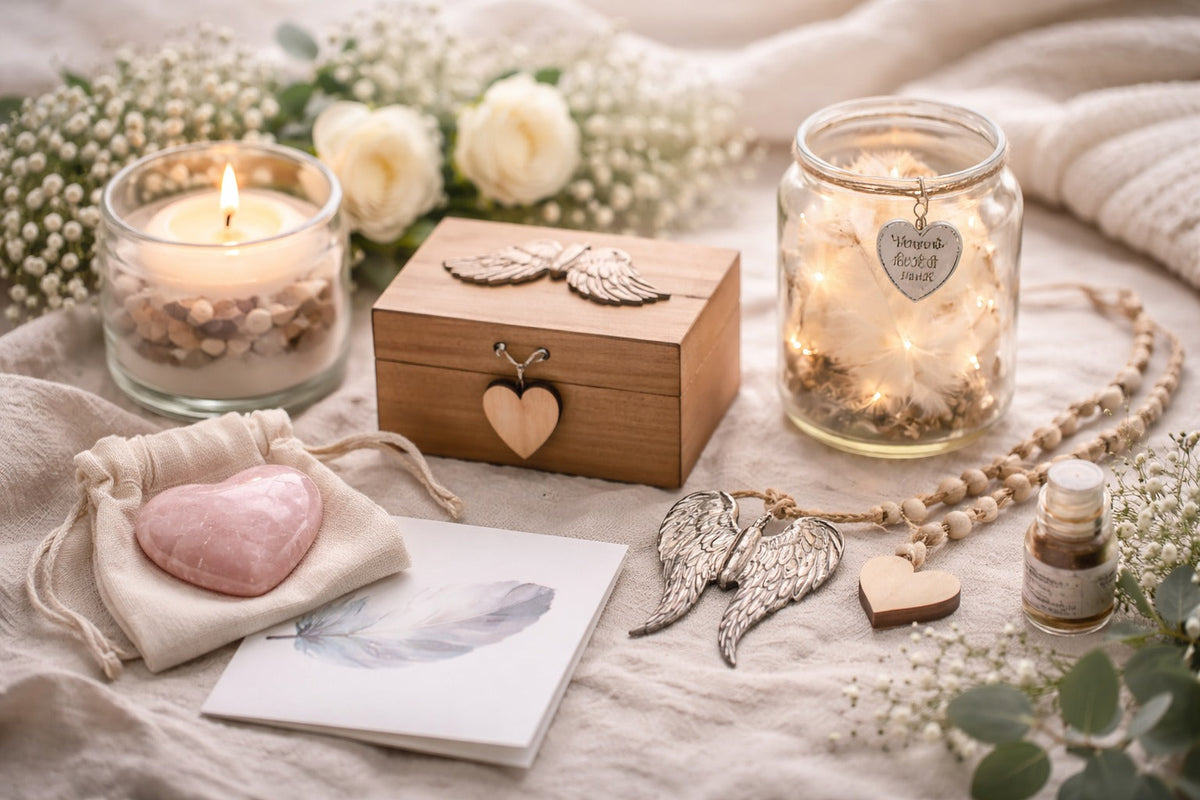
A keepsake box works differently. It holds. Fragments of a life shared, small items of no monetary value but full of meaning: a button, a movie ticket, a lock of hair. Each addition becomes a gesture of living memory.
Gifts of light: memorial candle
The flame of a memorial candle creates a ritual. Light it, pause, remember. This brief moment gives structure to grief and provides a tangible gesture. Some candles feature a name engraved in the wax or on the glass container. The light flickers. It warms.
Unique personalized items: the fusion of two names
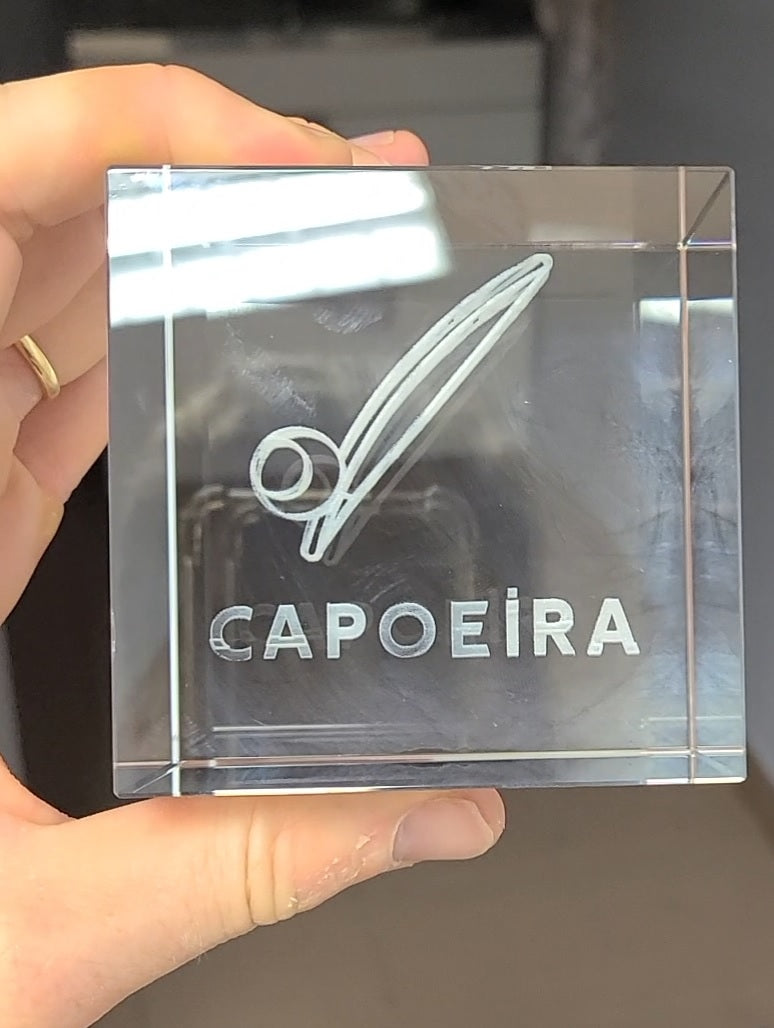
Among the most distinctive personalized keepsakes, the crystal digraphe holds a special place. This handcrafted French item brings two names together in an optical illusion: depending on the viewing angle, one appears, then the other. The two coexist in the same piece of crystal, engraved by laser. It is a work made in France, designed to embody a connection rather than erase it.
Placed on a shelf and illuminated by light from a window, the crystal digraphe plays with reflections. The sparkle of the glass creates multiple angles, revealing one name, then the other. It is not a static keepsake: it comes alive with the time of day and the way it is viewed.
What personalization truly changes
A generic item offers comfort. A personalized bereavement gift honors a memory. The difference lies in the engraved name, the inscribed date, and the choice of material. These details mean that the object can belong only to that person and to that particular deceased loved one. A personalized gift after a death is based on this principle.
- Memorial jewelry with an engraved name or initial
- Photo frame or plaque with a personalized message
- Memory album to complete as grief unfolds
- Keepsake box for fragments of a life
- Memorial candle, ritualistic and luminous
- Crystal digraphe, a handcrafted optical illusion featuring two names
Each of these keepsakes appeals to a different sense: sight, touch, or light. Together, they form a range of thoughtful gestures, allowing you to choose according to the person, the relationship, and what you wish to say without words.
Comforting gifts to support someone through their daily grief
Some days, grief weighs heavily on the simplest actions: preparing a meal, opening the curtains, finding the energy to get through the day. It is then, in the burden of everyday life, that gentle gestures find their true place. Not to erase the pain, but to say without words, “I am here.”
A comforting gift hamper speaks with a discretion that grand gestures lack. A few carefully chosen tea bags, a scented candle, a book on grief such as Christophe Fauré’s Vivre le deuil au jour le jour or Sylvie Tenenbaum’s Traverser le deuil: these are silent companions. They do not fix anything. They offer support.
A memorial plant holds a special place among these thoughtful gifts. A bonsai or olive tree carries a symbolism of quiet strength and resilience. They grow slowly, without rushing, and remind us that life continues at its own pace. Unlike cut flowers, they endure. The bereaved person watches them grow and waters them, and this daily act becomes a quiet ritual of remembrance.
A handwritten sympathy card deserves careful attention. A sincere message, written by hand, creates something that no object can replace. Naming the deceased, sharing a specific memory, recalling a quality that will endure: these few lines become an emotional archive. They are kept and reread, sometimes years later.
And then there is practical help. It is often underestimated, yet frequently the most useful.
- Prepare a meal in an aluminum tray, ready to freeze, to ease the burden of the most difficult days.
- Offer to do the shopping without waiting to be asked.
- Look after the children one afternoon, giving them a few much-needed hours of quiet.
These gestures do not make headlines. They are not photographed. But for a family overwhelmed by formalities and emotional exhaustion, they can truly change a day.
For a grieving friend, the mistake would be to believe that an expensive gift speaks louder. It does not. A simple, sincere gesture always outweighs a spectacular gift chosen in haste. What matters is appropriateness: the right item, at the right time, without expecting anything in return.
These comforting everyday gifts do not seek to close the wound. They maintain a compassionate presence over time, long after the funeral and the initial condolences. They say that the grief has not been forgotten, that the person who died still matters, and that those who remain do not have to go through this ordeal alone.
Special circumstances: perinatal loss, bereaved families, funerals
Some losses call for an even more thoughtful approach. Perinatal loss, an extended family grieving together, the time of the funeral: these three situations all require a particular sensitivity, and each deserves careful consideration. The loss of a mother is another, with its own ideas of a gift for a mother’s loss.
Perinatal loss: a grief that often goes unnoticed
The loss of an unborn child or a newborn is one of the least socially recognized forms of grief. Yet the pain is real. It is absolute. A gentle, personalized symbolic gift takes on a special meaning here: a name engraved on a delicate object, a piece of embroidered fabric, an intimate keepsake box. These items do not seek to fix anything. They give the loss a name. They say that this child existed, that they had a name and a place in the family’s memory.
Emotional support during perinatal loss also involves speaking: mentioning the chosen name, acknowledging the pregnancy, and not downplaying the loss. An object bearing that name becomes much more than a comforting bereavement gift: it anchors an existence in the world of the living.
Giving to a bereaved family when you do not know everyone
What should you choose when you only know part of the bereaved family? The rule is simple: aim for something that everyone can share rather than something deeply personal. A gift for a bereaved family should be something everyone can keep without it feeling intrusive to anyone.
- A living plant, a discreet symbol of continuity, can be placed in the home without requiring any mental space.
- A hamper of practical treats, delivered after the funeral, offers comfort during the first few days without being intrusive.
- A donation to a cause dear to the deceased can sometimes replace a physical gift: some traditions, particularly in certain African or Asian communities, favor this collective gesture over any material gift.
The most important thing is to avoid items that are too personal and could cause discomfort among relatives who do not share the same memories of the deceased.
The funeral: presence, flowers, card
At the funeral itself, being there in person remains the most important gesture. It says more than any object can. By coming, you are already giving what is most precious: your time and attention. When it comes to objects, gift ideas for a funeral should be chosen with the same sensitivity.
Flowers traditionally accompany the ceremony. In France, chrysanthemums are the quintessential flowers of grief, but other cultural traditions favor white flowers or unscented arrangements. A sympathy card discreetly tucked inside, with a few sincere words, extends your presence beyond the day of the funeral.
After the ceremony, bereavement gift ideas and advice all point to the same thing: do not disappear. It is in the weeks following the funeral that isolation truly sets in. A keepsake, a message, a shared meal: these gestures, offered at different times, remind the bereaved family that they are not forgotten when the silence returns.
How to give a bereavement gift thoughtfully and compassionately
Grief does not follow a calendar. This is the first thing to keep in mind before choosing a gesture of support. The first few hours, weeks, and months each shape a different kind of pain, and the right time to give a bereavement gift is never set in stone.
Immediately after a death, the bereaved person is often in a state of shock. A gift hamper, a few scented candles, a prepared meal: these gentle gestures meet an immediate need without requiring the person to think ahead. A few weeks later, when the silence sets in and relatives are less present, a personalized keepsake can sometimes have an even greater impact. It says: you have not been forgotten. Compassionate presence does not end the day after the funeral.
What to avoid
- Clichés such as “time heals all wounds” or “they are in a better place.” Even if sincere, these phrases close off the space of grief rather than welcoming it.
- Impersonal gifts bought in five minutes. Your intention is reflected in the item you choose.
- Pressure to “feel better.” A bereavement gift is not meant to erase the pain: it offers support, maintains a connection, and honors what was.
- Long messages in the accompanying card. Three sincere, handwritten sentences are worth more than a perfect message copied from the internet.
How to present the gift
A handwritten note is enough. There is no need to find the perfect words. Mention the deceased, share a memory, or simply say “I am thinking of you”: these few lines can transform any object into an authentic gesture of support.
The gift does not need to be delivered in person. Sometimes sending it protects the bereaved person from having to manage their emotions in front of someone else. It is also a form of respect.
A symbolic gift has no expiration date
A personalized item given six months after a death remains a powerful gesture. Often, it is even more powerful, because it proves that the memory of the deceased endures beyond the first few weeks. When supporting someone who is grieving, these unexpected gestures matter most.
Comforting someone after a death means accepting that emotional support during grief is an ongoing process. A keepsake given for a birthday, All Souls’ Day, or simply “because I was thinking of you”: none of these moments is too late.
If you are looking for how to choose a thoughtful gift for a bereaved loved one, an item that brings two names together in a single form, visible from different angles, carries something rare: the promise that two people once existed together. This is precisely what Digraphe creations seek to convey, silently and enduringly.
FAQ
What gift should I give someone who is grieving?
An item that says “I haven’t forgotten” is often worth more than a bouquet. A soft blanket, a candle, a prepared meal: these thoughtful gestures ease the burden of difficult days. A personalized item bearing the deceased’s name, engraved, sculpted, or designed to last, touches the heart differently. It does not replace time. It remains, silently, like a presence.
What is a good sympathy gift after a death?
The right gift does not try to make it seem as though nothing happened. It acknowledges the loss. A notebook for recording memories, a plant to nurture, an item bearing an engraved date or name: these simple gestures, chosen with intention, touch more deeply than an expensive gift bought in haste.
What is a symbolic bereavement gift?
It is an object that carries a meaning beyond its material. It keeps alive the bond between the bereaved person and the one they have lost. A memorial piece of jewelry, a personalized creation with the deceased person's name, an object engraved with a date: all are gifts that stand the test of time and become, day by day, a discreet presence.
What symbols are associated with mourning?
The white flower, the lit candle, the black ribbon: these are the best-known symbols of mourning. But in the practice of gift-giving, other symbols emerge: the engraved name, the date preserved in the material, the handmade object. These modern forms of remembrance speak to those who remain, without heaviness or ritual coldness.
A symbolic gift of mourning: a gesture for today, a trace for tomorrow
A symbolic gift of mourning does not close anything. It does not promise healing, nor does it replace any absence. It does something more subtle and more lasting: it places a name in the material, a date in the metal, a memory in an object that the bereaved person can touch, wear, look at. The right gesture is not the most expensive or the most spectacular. It is the one that says, without detour, that the deceased person continues to exist in the memories of those who remain. And that intention, when reflected in an engraved piece of jewelry, a flipbook, or a light lit every evening, has no expiration date.